
- Published on 30 Jul 2026
- Last updated on 30 Jul 2026
- Reading Time: 6 minutes
Introducing AutoEval to the Arena leaderboards
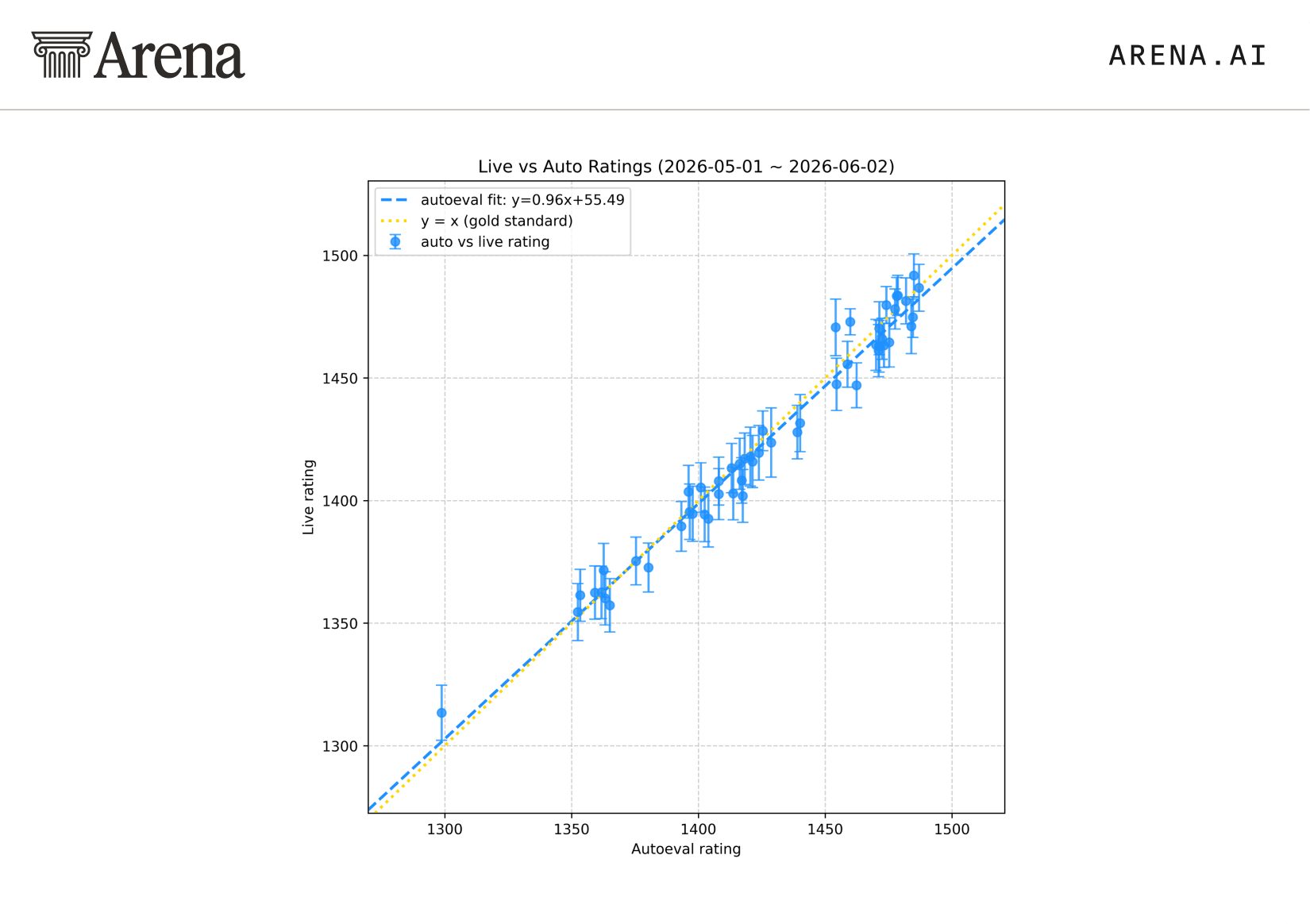
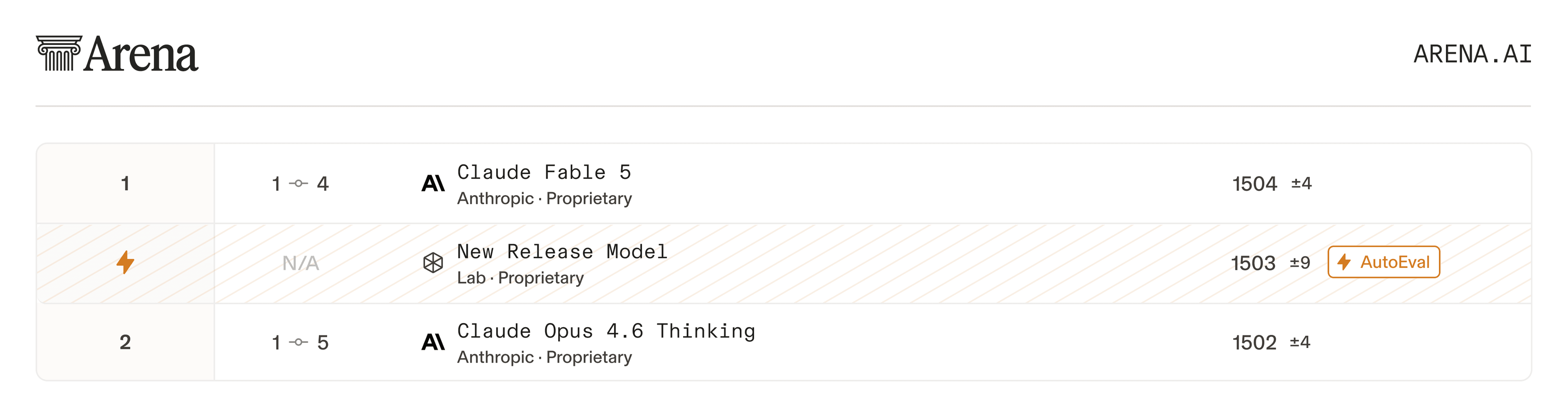
At Arena, our evaluations are dynamic and grounded in real-world use. But real-world signals take time to collect. Today, we’re introducing AutoEval scores to provide immediate, calibrated model ratings on real tasks when waiting for human votes to accumulate.
AutoEval provides a Day-1 signal as soon as a model launches. Scores are clearly labeled “AutoEval,” then updated once enough human votes arrive to validate them. This helps the community identify the best models for their tasks, sooner.
How do AutoEval scores work?
Instead of waiting on votes, we train a Reward Model (RM) that captures human preference, then use it to cast votes automatically. By integrating live human votes with these RM-generated proxy votes, we unlock:
- Rapid feedback: RM-based voting gives a ranking in under an hour, not days.
- High flexibility: Because we control the prompts the RM votes on, we can target evaluation on specific domains.
Arena AutoEval works across text, vision, image generation, and coding domains, supplementing our human evaluation with rapid, targeted automation where just human voting cannot scale quickly enough.
Reward Model Training
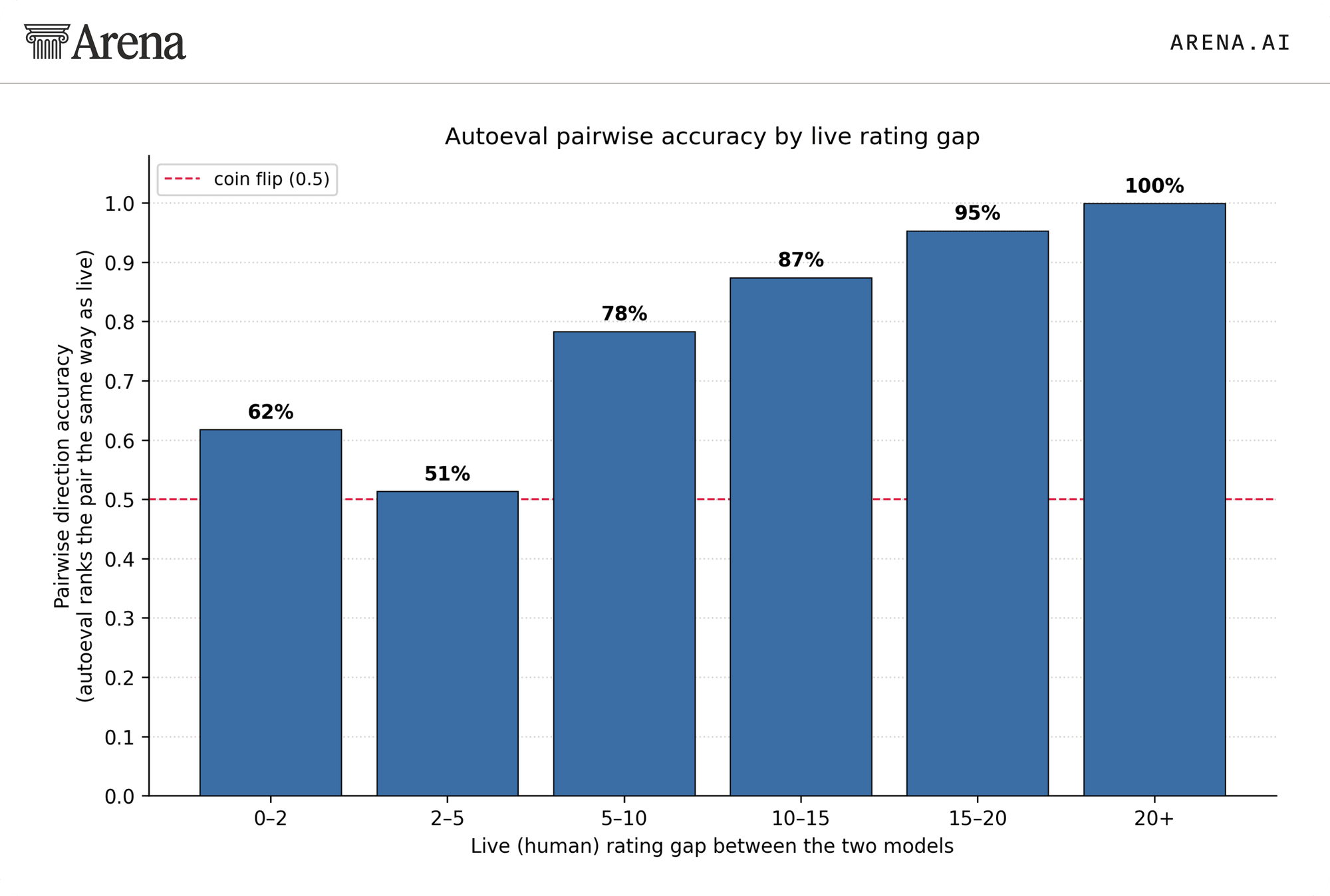
AutoEval starts with data. We train a reward model on Arena’s large-scale human preference dataset, consisting of millions of pairwise comparisons from live votes, so that it learns to approximate human judgments. At its core, the model is a pointwise reward model: it maps each individual prompt-response pair to a scalar score. We train it on pairwise comparison data so that the resulting score rankings consistently align with human preferences.
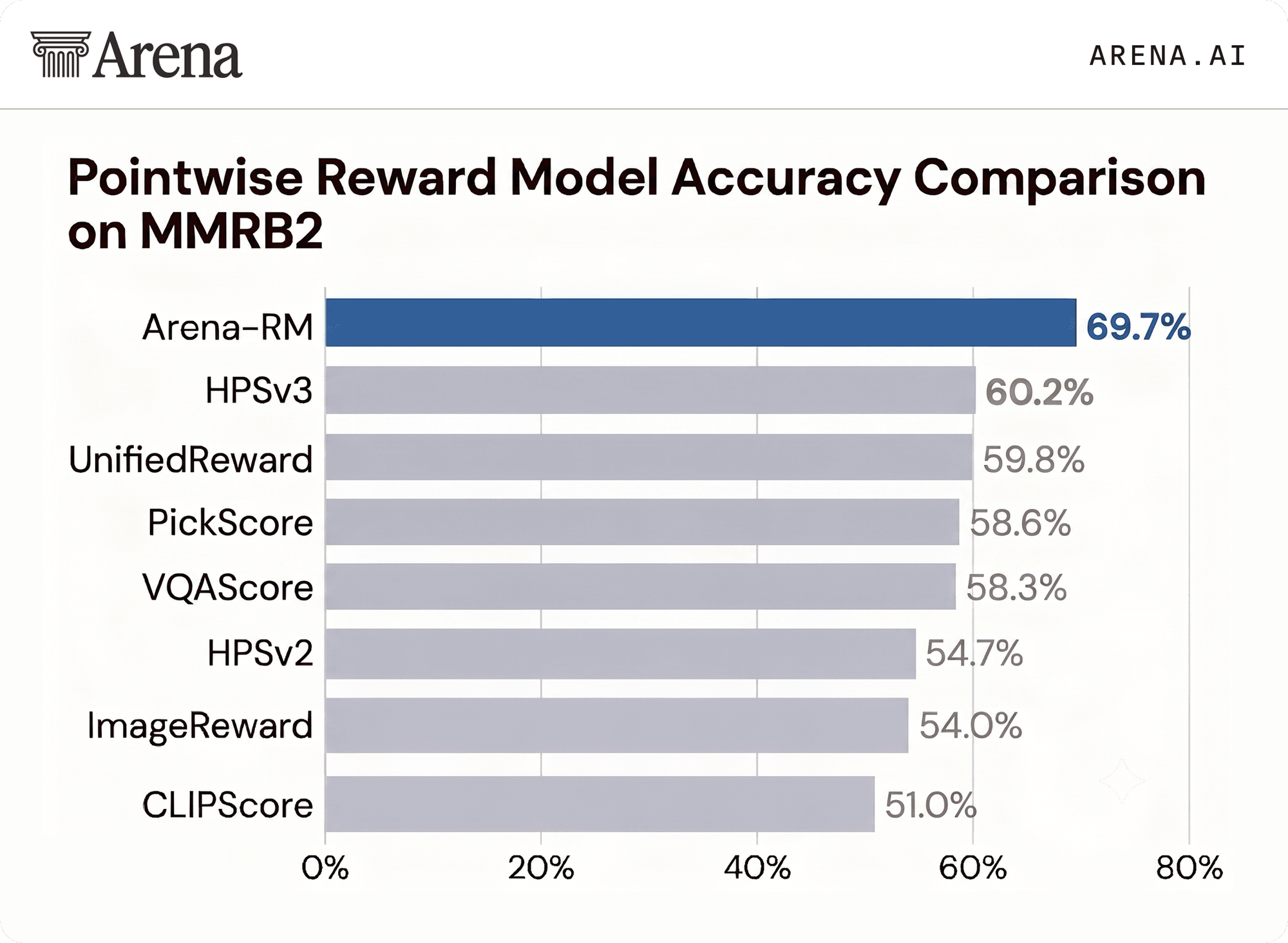
Learning from massive real preference data pays off. Our text reward model predicts human preferences 8–10% more accurately than frontier LLM judges (Gemini-3-flash/pro, GPT-5). Many prompts on Arena are hard and complex, and the competing models are strong, so there’s often no single response that clearly dominates in all aspects. In those cases, we found that LLM judges struggle to make the final call, while our reward model still captures what humans actually prefer.
Training a reward model for a live service is not a one-time learning problem. The target, the data, and the models being evaluated all continue to change. We encountered several challenges:
- Human preferences are a moving target. What users consider a good response changes as expectations, interaction styles, and use cases evolve. Historical feedback provides breadth and stability, while recent feedback reflects these shifts. Effective training must grounded in the vast historical feedback signal while adapting to the recent trend drifting over time.